

A practical guide to AI visibility, China tours marketing, and how operators can improve their content for ChatGPT, Gemini, and Claude by using AI Visibility Optimization tools like GeoSnake.
Travel discovery is moving into the AI layer. This article explains why that matters for China tours, how Chinese tour operators can adapt, and where a tool like GeoSnake fits into the workflow.
Why AI is changing China tour discovery
Travelers no longer start their planning with a search bar alone. They ask conversational AI systems for help comparing cities, building itineraries, checking travel practicality, and finding a tour operator they can trust. That means the first impression of a China tours brand is increasingly shaped by how often, and how clearly, it appears inside AI-generated answers.
The change is bigger than a channel shift. Classic search still matters, but generative tools are now compressing research, comparison, and recommendation into a single response. When a traveler asks ChatGPT, Gemini, or Claude what to do in Beijing, which company offers private China tours, or how to plan a two-week route, the models do not just list links. They synthesize what they believe is the most useful answer. If your content is thin, generic, or hard to interpret, you can be absent from that answer even if your products are strong.
For Chinese tour operators, this is a clear warning and a clear opportunity. The warning is simple: if your pages are not optimized for AI, the models may surface a competitor instead. The opportunity is just as simple: if your content is structured, specific, and trustworthy, you can become the brand that gets recommended when travelers ask real questions about China tours.
What AI-ready content looks like
AI-ready content is not just keyword stuffing with a modern label. It is content that helps a model understand who you are, what destinations you cover, which travelers you serve, and why your offer is worth recommending. For China tour operators, that usually means city pages, itinerary pages, FAQ pages, and practical travel articles that answer common questions in plain language.
The strongest content tends to cover one destination or one intent at a time. A page about Beijing should not try to do everything at once. It should explain what travelers can see, how long they need, what kind of tour works best, and what makes the experience distinctive. A page about Shanghai should do the same for the city, while a food page should focus on culinary intent, not general sightseeing. This clarity helps both search engines and AI systems understand the page more reliably.
Destination pages with real depth
Destination pages are often the first place an AI system looks when it tries to answer a trip-planning question. If a page only says "top-rated tours" and repeats the city name, it offers very little context. If it explains what travelers can do, how the city fits into a route, and who the experience is best for, it becomes much more useful. That is why detailed city pages matter so much for China tours.
Itineraries and FAQs
Itinerary pages are especially valuable because they match the way people actually ask AI for help. A traveler may type "best 10-day China itinerary" or "what should I combine with Beijing on a first trip to China?" Those are high-intent, natural-language prompts. If your site has a strong answer, the model has a better chance of including your brand in the response. If you need a practical example, see The Perfect Two-Week China Itinerary and China Travel Tips Every First-Timer Should Know in 2026.
Internal links build topical authority
Internal links are not just an SEO habit. They help AI systems see that your site has a real content ecosystem rather than a set of isolated pages. A Beijing guide should connect to broader travel advice. A food article should connect to route planning. A city page should connect to seasonal tips, itinerary ideas, and practical traveler guidance. That web of references helps establish topical authority. For example, Beijing City Guide for First-Time Visitors becomes stronger when it points to broader planning content and when the broader planning content points back.
Why Chinese tour operators need to optimize now
China travel is a category where trust, clarity, and up-to-date detail matter a lot. International travelers often want to know about visas, transport, payment apps, language support, route logic, food, and seasonality before they book anything. If your content answers those concerns clearly, you become more useful to both the traveler and the model.
That usefulness is what wins mentions. AI systems reward pages that are easy to summarize and hard to misunderstand. They also reward sites that demonstrate consistency. If your brand appears across city guides, itineraries, food posts, and practical travel tips, the model is more likely to treat you as a credible China tours source. If your content is scattered or overly promotional, the signal gets weaker.
This is where the category is changing. Tour operators used to think in terms of ranking, links, and traffic. Now they also need to think in terms of mention rate, answer share, citation frequency, and competitor displacement inside AI responses. A brand can rank well in search and still lose visibility in ChatGPT or Claude if the content does not support those systems well.
The best response is a content strategy built for both people and models. That means:
1. Cover the city and itinerary questions travelers actually ask. 2. Write in clean, direct language that an AI can summarize. 3. Connect related articles with internal links. 4. Refresh pages when travel conditions change. 5. Track visibility in AI outputs, not only in classic search reports.
If you want another useful example of a content cluster that supports destination discovery, look at The China Food Bucket List. Food content often performs well because it combines emotional appeal, destination specificity, and clear traveler intent.
How AI search changes content strategy
There is a common mistake in travel marketing: writing for keywords but not for comprehension. AI systems are increasingly better at reading around a phrase, but they still need structure, context, and strong topical signals. If a page on China tours is vague, the model has less to work with. If the page is detailed, helpful, and connected to related resources, the model can infer much more about your brand.
Make each page answer a real question
Instead of asking, "What keyword should we target?" ask, "What question is a traveler trying to solve?" That shift changes the page from a marketing asset into an answer asset. It also makes your content more likely to be cited or summarized accurately by AI.
Use examples, not just claims
Travelers trust specifics. Tell them which cities fit a first trip, which routes save time, and which experiences are best for families, couples, or food lovers. Specificity helps the reader and gives the model more useful information to work with.
Keep the structure obvious
Clear headings, short paragraphs, and strong internal navigation help readers scan quickly. They also help models understand what each section is about. For a China tours brand, that is especially important because the same site often needs to cover cities, attractions, transportation, food, and travel logistics all at once.
Where GeoSnake fits
A tool like GeoSnake is useful because it helps teams move from guesswork to measurement. GeoSnake helps brands increase visibility across ChatGPT, Gemini, and Claude, while giving clear scores, competitor benchmarks, and recommendations you can act on. It also supports business scans, optimized SEO blog generation, and tracking so you can see how AI models mention you, or do not mention you, over time.
That matters because AI visibility is not static. Model behavior shifts. Competitors publish new content. Traveler prompts change. A page that is strong this month may need another pass next month. GeoSnake is helpful because it gives hands-on advice rather than just a vague dashboard. If your goal is to improve your score and understand where your content is falling short, that kind of feedback loop is exactly what you need.
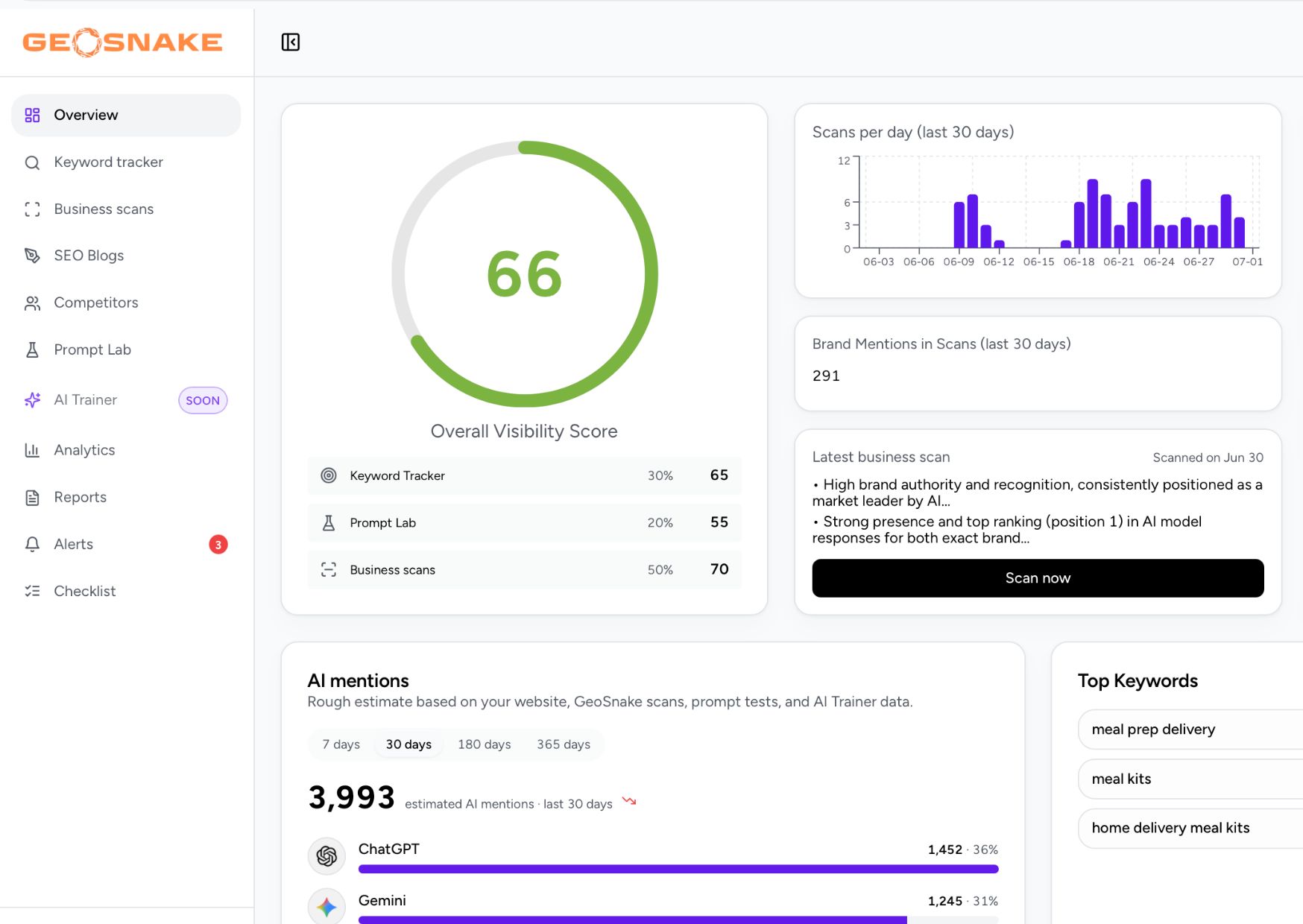
What GeoSnake can help with
GeoSnake is designed to help teams track AI visibility across major models, compare a brand to competitors, generate optimized SEO blogs, run business scans to spot gaps, and measure whether ChatGPT, Gemini, and Claude mention the brand.
That is especially relevant for Chinese tour operators because the category is content-heavy and highly competitive. The operators who see what the models are saying, then act on that information quickly, will usually move faster than those waiting for classic SEO reports alone.
GeoSnake coupon and feedback program
GeoSnake has a free plan available, and if you upgrade, code ASIAT15 gives users an extra 15% off the first paid subscription plan on Pro or Business. The platform is also currently in development, so users can earn up to 100 extra credits by sharing feedback that helps GeoSnake improve and become even more useful for tour operators around the world.
If you want to see the product itself, start at GeoSnake and explore how its AI visibility workflow fits into your content process.
What China tour operators should do next
The practical next step is not to rewrite everything at once. Start by auditing the pages that matter most: your city pages, your main itineraries, and the articles that support booking intent. Then make sure those pages use plain language, answer traveler questions, and link to the rest of the site in a way that builds a clear content map.
Use internal backlinks to show the model how your site is organized. For example, a travel tips article should point to China Travel Tips Every First-Timer Should Know in 2026. A route-planning page should point to The Perfect Two-Week China Itinerary. A destination page should point to Beijing City Guide for First-Time Visitors. Those links are small, but they help create a stronger content graph.
Next, make sure your content is useful enough to be quoted or summarized cleanly. Remove filler. Add examples. Clarify the traveler benefit. Mention the city, the trip length, the audience, and the use case. If the page is about a tour in China, say that plainly. If the page is about a regional itinerary, explain why it works better than a generic one.
Finally, start measuring AI visibility as part of the content workflow. Track how your brand appears in responses. Compare that with competitors. Update the content, then measure again. That simple loop can tell you more than a static SEO report, because it reflects the way travelers are now discovering travel brands in real life.
Related ChinaTours reading
For more traveler-focused context, see China Travel Tips Every First-Timer Should Know in 2026, The Perfect Two-Week China Itinerary, Beijing City Guide for First-Time Visitors, and The China Food Bucket List.
Helpful external resources
If you want to understand the platforms shaping discovery, it helps to look at ChatGPT, Gemini, and Claude directly. For the hands-on AI visibility workflow mentioned in this article, visit GeoSnake.
Final takeaway
AI is quickly becoming a major discovery layer for travel. For Chinese tour operators, that means the competition is no longer only about who ranks first in search. It is also about who gets mentioned inside AI-generated answers, who is trusted by the model, and whose content is structured well enough to be reused in recommendations.
The brands that win will be the ones that publish useful content, connect it with smart internal links, and measure how AI systems respond. That is the real future of China tours marketing: not just visibility in search, but visibility in the answer itself.